.svg)

.png)
.webp)
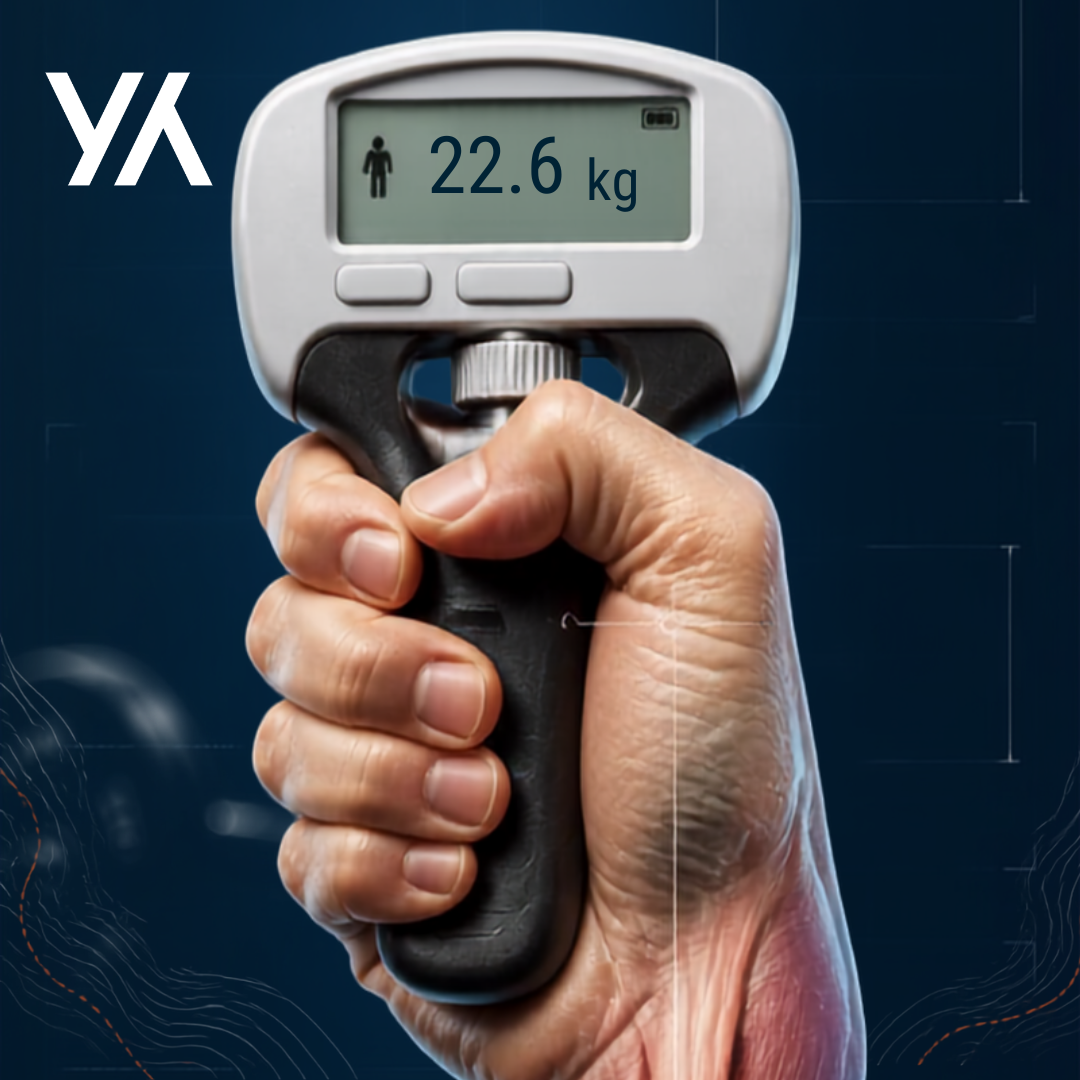
What do you think is the fastest way to tell you more about your risk of dying in the next few years? Is it with blood samples? Physiology exams? As interesting as it sounds, the best way to know it is by… squeezing as hard as you can.

One Study Changed
In 2015, The Lancet published some conclusions from the Prospective Urban-Rural Epidemiology study. Researchers tracked nearly 140.000 adults across 17 countries, measuring their grip strength with a handgrip dynamometer and following their health outcomes for several years.
Results showed that every 5 kilogram reduction in grip strength was linked to a 16% higher risk of death by any cause. The most surprising conclusion is that strength turns out to be a stronger predictor of all-cause and cardiovascular mortality than blood pressure.
But Why Do Your Hands Reflect Your Whole Body?
Well, in fact, grip strength is not only about your hands. It extends to something much broader. An editorial accompanying the Lancet study found that grip strength is a powerful predictor of future disabilities and mortality, not only in older adults, but in middle-aged and young people as well.
That’s because gripping is created by combining efforts from your nervous system, your muscle and your connective tissue all at once. When that system starts to decline, a condition called Sarcopenia, grip strength is one of the first things that show it.
A research published in the Journals of Gerontology has used grip as a primary marker because it’s easily measurable and closely tied to lower-body strength and mobility outcomes, making it practical to understand overall muscular health when more complex testing isn’t available
A 2023 study published in the Journal of Cachexia, Sarcopenia and Muscle found a measurable link between grip and DNA methylation age acceleration, which is a marker used to estimate biological aging.
Falls, Independence and the Domino Effect
Beyond its statistical significance, grip is also connected to your risk of falling. A weaker grip often is a sign of reduced neuromuscular coordination and upper body stability, both of which matter in the split second it takes to catch yourself.
Since falling is one of the leading causes of injury-related decline in the older generations, you can start to see a connection that falling is also a preview of how someone might move for the next few years.
👉 Try Papayya's FREE 14-day trial right now!
.png)
What This Means for your Workouts
The best part of this article is that grip strength is trainable at almost any age. Functional work has been shown to support grip strength over time, alongside the broader muscular and neurological system it reflects.
Papayya Fitness’s role is to take part in a broader action for people training for the long game. Our workouts are set to build functional and full-body movement for the real world, which is totally different from training just for aesthetics. Working your grip strength stretches to the same motto as us: it rewards consistency, compound movement and training your body as an integrated system.
For Papayya, that longevity is built through the fundamentals and that strong grip is often a sign that a lot of other things are going right as well.

 FACEBOOK


