.svg)

.png)
.webp)
We all know someone that is probably wearing a tracking ring, watch or a strap right now. Wearable technology has quietly become the most normalized piece of health tech in our daily lives and, according to the American College of Sports Medicine, it’s the defining trend in fitness. A survey of 2000 clinicians, researchers and exercise professionals stated that Wearable Technology is the number one trend in the industry.
The real problem exists in understanding what you’re tracking. There’s only a few people that actually know what those statistics really mean, or which ones matter for long-term health. So, what about changing that?

Interpretation is the Real Detail
Nearly half of US adults now own a fitness tracker or a smartwatch, which means that the real question nowadays is how they should be using them. Even the devices have been changing. We used to have step counters and now we track blood glucose and heart rate variability data directly into training plans. Actually, more than seven in ten wearable users in 2024 reported actually using that data to adjust how they trained or recovered.
So let’s understand the two data points that have been causing the most confusion: HRV and Sleep
Heart Rate Variability (HRV)
Heart Rate Variability is the variance in time between individual heartbeats. It is considered one of the best objective indicators of physical fitness. In plainer terms, your heart doesn’t beat consistently. Even at a steady heart rate, the actual gaps between beats fluctuate slightly and those tiny fluctuations reveal how well your body is actually handling stress, recovery or daily tasks.
A rise in HRV tends to reflect a positive adaptation and better recovery, while a drop tends to reflect stress and reduced recovery. So, the higher your HRV, the fitter and better recovered you tend to be.
Nevertheless, there’s no ideal number that applies to everyone, especially across different training backgrounds, which means the terms “higher” and “lower” are extremely subjective and personal.
A practical way to understand HRV is that the best way to measure it is first thing in the morning, when you’re rested and relaxed. Always be consistent in timing so that you can make that data really meaningful.
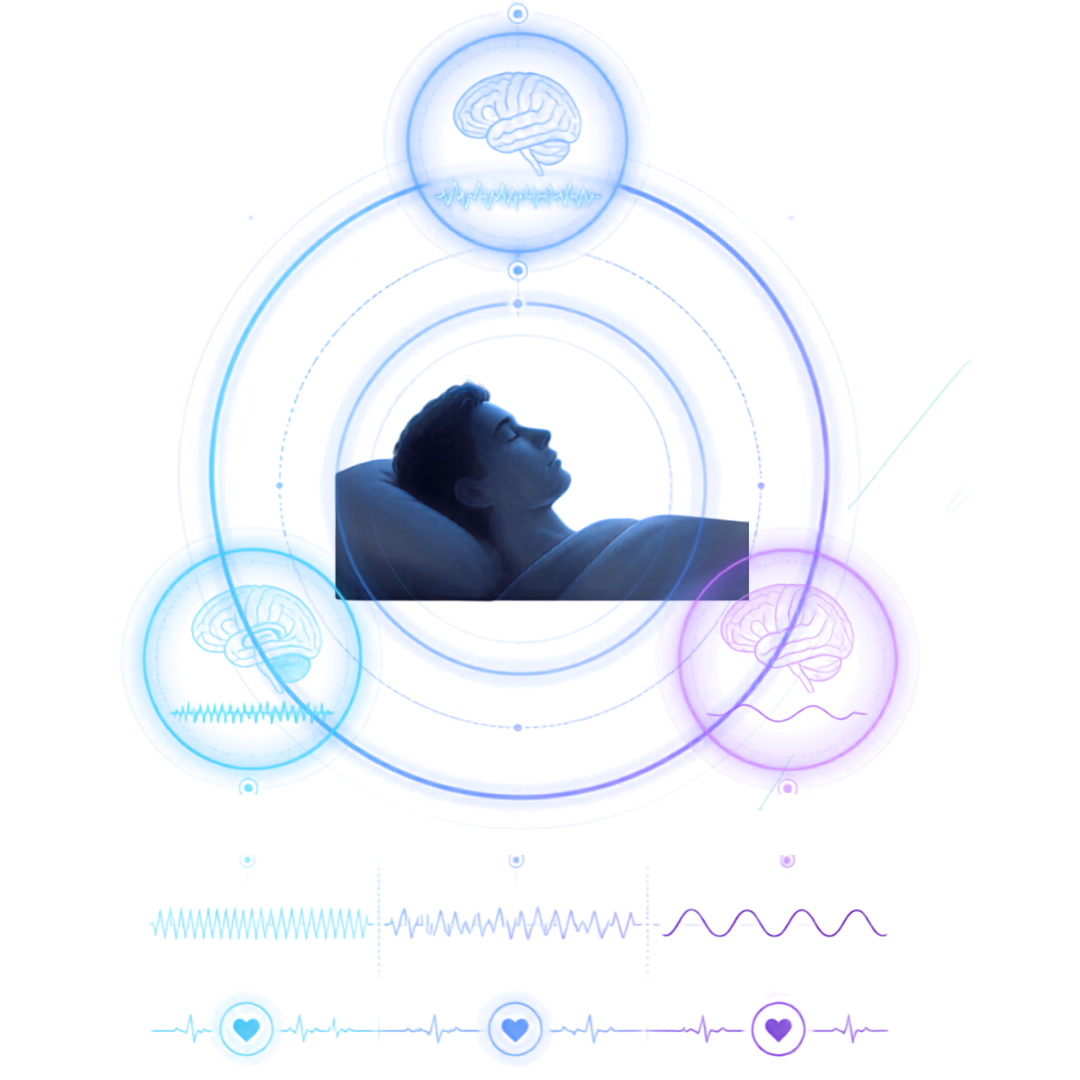
Sleep Stages
Most wearables break sleep into stages: light, deep and REM. This matters because they all have different jobs: when in deep sleep, your body is fully relaxed which is crucial for physical recovery and tissue repair. REM is more closely related to cognitive processing and emotional regulation.
Keep in mind that two nights of identical sleep can have different impacts in you depending on how that time was distributed between the cycles.
So, when looking to track your sleep, don’t treat it as a single’s night stage breakdown. Watch your trends over weeks and analyse if your deep sleep is consistently shrinking as training load increases? Is your REM sleep dropping on high-stress weeks? That will show you a pattern that tells you more than a one night’s chart.
.png)
Read the Data without Getting Lost in It
Looking at your biological feedback has been allowing people to personalize their training and getting real-time insight into how their body is responding, but there’s a risk when overcorrecting becomes an obsession.
Some reflections on the 2026 trends showed that some people are now choosing fewer metrics and learning to trust how their body feels over what a device says and balancing data information with what your body’s telling you is really the goal.
Papayya’s intention is to build a relationship between technology and your body over time. Wearables are a tool that builds self-awareness, habits and training consistency, which are the main values behind Papayya - using data to support consistency and not to chase perfection.
Tech is only as good as your understanding of it. Learn what the numbers mean, watch your own trends and let the data inform your habits instead of replacing your judgement.
Sources
- ACSM — The Future of Fitness: ACSM Announces Top Trends for 2026
- Recreation Management — ACSM Announces Top Trends for 2026
- Recreation Management — ACSM Announces Top Fitness Trends for 2026
- HillRag — 2026 Fitness Trends
- fitnessupdates.org — What the 2026 ACSM Fitness Report Found
- ScienceForSport — Heart Rate Variability (HRV)
- Grady Health — Heart Rate Variability (HRV): What It Says About Health
- PMC — Heart Rate Variability Applications in Strength and Conditioning: A Narrative Review
- WHOOP — Heart Rate Variability: What It Means for Fitness and Health
- HSS — How to Use Heart Rate Variability Data in Your Training

 FACEBOOK


