.svg)

.png)
.webp)
The fitness world loves shortcuts. Everywhere you look, there’s a new “revolutionary” way to workout that gets you shredded with only 5 minutes of exercise a day. Basically, they use the concept of High-Intensity Interval Training (HIIT) of maximizing efficiency and use it to promise the world.
But does science back up these ultra-short sessions?
While these super short workouts can bump your cardiovascular numbers a bit (if you’re starting from 0), if you’re looking to lose weight, build muscle and improve your overall health, then the science-backed sweet spot is a 30-minute workout session. (ACSM Core Position Stand)
%20(1).png)
What Makes a Workout "HIIT"?
To make it simple: a hiit workout is one that makes your cardiovascular system alternate between maximum effort (80% to 95% of the maximum heart rate) and active recovery (50% to 60% of the maximum heart rate).
Why 30 Minutes is the Sweet Spot
Even though the majority of lab-driven tests on hiit workouts only adds up to about 10 to 15 minutes, a safe and complete workout always requires, without exception, a dynamic and correct warm up, rest periods and proper cool-off stretching, hence the 30 min mark:
- The Non-Negotiable Warm-Up (5 to 10 minutes)
Any workout can put stress on your joints and nervous system and hiit workouts aren’t the exception. Jumping directly into a maximum-effort sprint or explosive jump squat without preparation is an injury risk.
A quick 5-to-10-minute warm-up is essential because it heats up your muscles so they don't tear, and opens up your blood vessels to deliver the oxygen your body needs.
When an app promises a "10-minute total HIIT workout," they are either skipping the warm-up (dangerous) or reducing the actual high-intensity portion to just 2 or 3 minutes (ineffective), either way, don’t fall for it.
This is exactly why relying on a generic app is a trap and why you actually need an online personal trainer. A real trainer builds those non-negotiable safety buffers into your routine, keeps you accountable to them and customizes the intensity so you actually get the science-backed results of a 30-minute workout without wrecking your body.
- 10-minute of actual exercise is the absolute minimum
Doing jumping jacks for 5 minutes may seem enough (or, if you’re a beginner, a torture), but the reality is that, in order to spark any physiological changes, you heart and lungs need a sustained stimulus, meaning, at least 10 minutes.
- The "Afterburn" Effect (EPOC)
HIIT triggers an "afterburn" effect, meaning your body keeps burning extra calories for hours after you finish working out to repair itself and recover.
To get this bonus calorie burn, you need the right balance of intensity and time. Research shows that doing intense intervals for 15 to 20 minutes keeps your metabolism elevated for up to 24 hours. If you cut the workout down to just 5 or 10 minutes, that metabolic afterburn pretty much disappears.
.png)
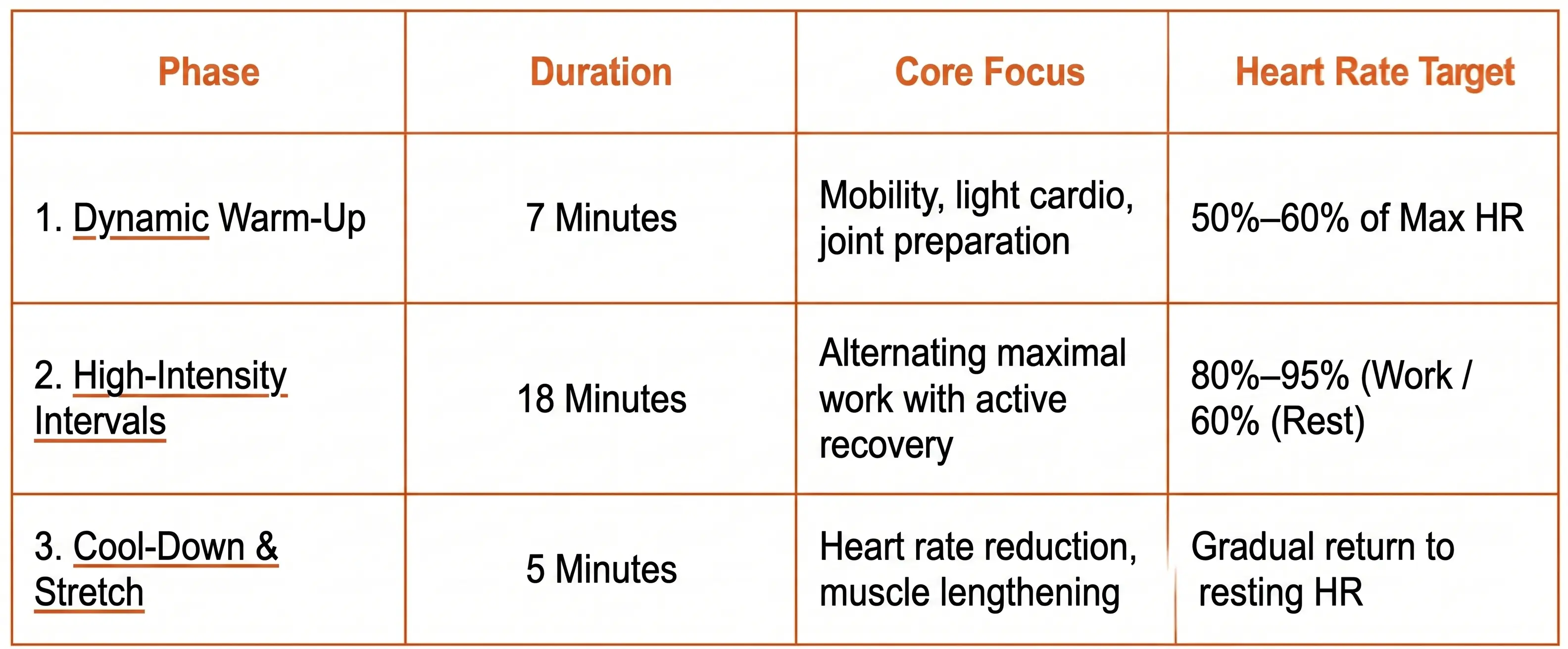
Example of a Papayya Optimized 30-Minute HIIT Workout
To see how this science translates to the gym floor, a well-structured, 30-minute session balances preparation, execution and recovery perfectly:
You can trigger the exact same metabolic response right in your living room with nothing but some resistance-bands, for example.
Sources:
American College of Sports Medicine Core Position Stand (PubMed) https://pubmed.ncbi.nlm.nih.gov/21694556/
American Heart Association Journal: Circulation (Exercise and Cardiovascular Health) https://www.ahajournals.org/doi/full/10.1161/01.CIR.0000048890.59383.D
American Council on Exercise (ACE): High-Intensity Interval Training Protocols https://www.acefitness.org/resources/pros/expert-articles/5834/high-intensity-interval-training-for-clinical-populations/
The Journal of Physiology: Low-Volume HIIT for Cardiometabolic Health https://pubmed.ncbi.nlm.nih.gov/33760255/
Frontiers in Physiology: Systematic Review of Low-Volume HIIT Total Duration and Buffers https://www.frontiersin.org/journals/physiology/articles/10.3389/fphys.2025.1736441/full
The International Journal of Exercise Science: HIIT and Post-Exercise Recovery Oxygen Consumption https://pmc.ncbi.nlm.nih.gov/articles/PMC5685083/
The Journal of Strength and Conditioning Research: Effect of Exercise Duration on EPOC Magnitude https://pubmed.ncbi.nlm.nih.gov/17166111/

 FACEBOOK


